





Update Location
Enter a ZIP code to get product recommendations and information tailored to your area.
The battery-powered Comfort Wand® gives your hands a break with its one-touch continuous spray.
The Trigger Sprayer is all about great value and ease of use. Simply point and squeeze.
The best value for large areas. Mix the specified amount of product with water in a backpack, pump, hose-end, or power sprayer then spray uniformly as a broadcast or spot treatment. You can also use with the Ortho® Dial N Spray® Hose-End Sprayer and eliminate measuring and mixing altogether!
Simply attach the battery-powered Ortho® Comfort Wand® from your previous bottle to your new Refill bottle to spot treat weeds with a continuous stream — no bending or pumping required.
Attaches to a garden hose to treat large areas quickly and easily. No mixing or measuring!
Perfect for spot-treating! Simply point and squeeze.
Active Ingredients
Cautions
Disposal Methods
Product Label
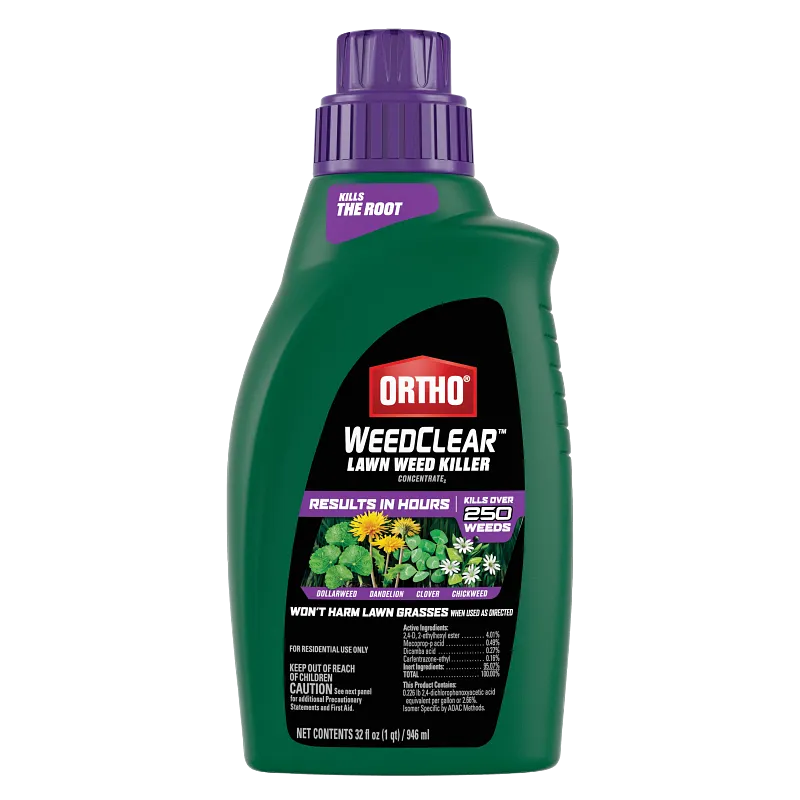
Kill weeds in your Southern lawn with Ortho® WeedClear™ Lawn Weed Killer Concentrate2. This lawn weed control product kills all listed weeds without harming your lawn (when used as directed). The formula produces results in hours and kills over 250 major broadleaf weeds, including dandelion, chickweed, clover, dollarweed, spurge, oxalis, and others as listed. Use this weed killer on warm-season lawn grasses, including Bahiagrass, Bentgrass, Bermudagrass (hybrid and common), Buffalograss, Centipedegrass, Perennial Ryegrass, Fescues, Kentucky Bluegrass, Zoysiagrass, and St. Augustinegrass (except Floratam). To use, mix this concentrate with water per label directions and apply using a tank sprayer or Ortho® Dial N Spray® hose-end applicator. Spray only until the surface of the lawn is wet. For best results, apply to actively growing weeds in spring or fall when daytime temperatures are below 90°F. Do not allow people or pets to enter the treated area until sprays have dried. This 32 fl. oz. container of Ortho® WeedClear™ Lawn Weed Killer Concentrate2 treats up to 10,600 sq. ft. of Bentgrass, hybrid Bermudagrass, Buffalograss, Centipedegrass, and St. Augustinegrass (except Floratam); or 5,300 sq. ft. of Bahiagrass, common Bermudagrass, Fescues, Perennial Ryegrass, Kentucky Bluegrass, and Zoysiagrass.
How to Use
Where Not to Use
Where to Use
When to Apply
How Often to Apply
Watering Tips
Using with other Products
Mixing Directions
Amaranth (purple, slender), Aster (heath, white heath, purple, white prairie), Artichoke, Austrian fieldcress, Bedstraw (catch-weed, smooth, northern, pineywoods), Beggar-ticks (hairy), Betony (Florida), Bindweed (field, hedge), Bitter Wintercress, Bitter-cress (hairy), Bitterweed, Black-eyed Susan, Blackmedic, Blood-flower milkweed, Blue lettuce, Brassbuttons, Bristly oxtongue, Broomweed, Buckhorn, Bull-nettle, Bur-clover, Burdock, Burweed (lawn), Buttercup (bulbous, creeping), Buttonweed (common (poorjoe), Virginia), Carolina geranium, Carpetweed, Catnip, Catsear (spotted (false dandelion)), Chamber bitter, Chickweed (common, mouse-ear, sticky), Chicory, Cinquefoil, Clover (crimson, Alyce, hop, rabbit-foot, red, strawberry, yellow sweet, whitesweet, white, Cockle, Cocklebur, Cocklebur spiny), Common mullein, Corn spurry, Creepingbeggar-weed, Creeping Jenny (creeping Charlie), Cupid’s shaving brush, Cudweed, Daisy (English, oxeye), Dandelion (common, false), Day-flower, Deadnettle, Dichondra, Dock (broadleaf, curly), Dogbane, Dog-fennel, Dollarweed (Pennywort), Dove-weed, Elderberry, Falseflax, False sunflower, Fiddleneck, Filaree (redstem, whitestem), Fleabane (daisy (annual), rough), Galinsoga (hairy, smallflower), Goldenrod, Groundivy, Groundsel, Gumweed, Hairy fleabane, Hawkweed (meadow, mouse-ear, orange, yellow), Healall, Heart-leaf drymary, Hemp, Henbit, Hoary-cress, Horsenettle, Horseweed, Jimsonweed, Johnny-jumpup violet, Knawel, Knotweed (prostrate), Kochia, Lambsquarters, Lespedeza, Mallow (alkali, bristly, common, dwarf, Venice), Marcela, Matchweed, Mexican-weed, Moneywort, Morningglory (bigroot, ivyleaf, red, tall, woolly), Mugwort, Mustard (ball, black, blue, hedge, Indian, tansy, tumble, white, wormseed), Nettle (stinging, tall, wood), Parsley-piert, Parsnip, Pearlwort, Pennycress, Pepperweed (perennial, Virginia), Pigweed (prostrate, redroot, Russian, smooth, tumble), Pineapple weed, Plains coreopsis (tickseed), Plantain (black-seed, bracted, broadleaf, buckhorn, hoary, narrow-leaf, slender, woolly), Poison ivy, Poison oak, Pokeweed, Prairie sunflower, Prickly lettuce (compass plant), Prickly sida, Prostrate knotweed, Puncturevine, Purslane (common), Pusley (Brazilian, Florida, large flower), Ragweed (bur, common, lance-leaf, western), Redstem filaree, Rough cinquefoil, Scarlet pimpernel, Shepherd’s purse, Smartweed (ladysthumb, pale, Pennsylvania), Smooth chaff-flower, Smooth dock, Sorrel (red), Sowthistle (annual, spiny), Spanish needles, Speedwell (bi-lobed, common, corn, ivyleaf, Persian, purslane, slender, snow, thyme-leaf), Speedwell, Spiny amaranth, Spurge (spotted, prostrate), Star of Bethlehem, Strawberry (Indian mock), Tansy ragwort, Tanweed, Thistle (blessed, bull, Canada, Flodman’s, musk, plumeless, prairie, Russian, Scotch, wavy-leaf, yellow), Trailing crown-vetch, Velvetleaf, Vervain (blue, hoary, prostrate, tall), Vetch (bird, hairy, milk, narrow-leaf, wild), Virginia creeper, Western clematis, Western salsify, Wild aster, Wild buckwheat, Wild carrot, Wild four-o-clock, Wild garlic, Wild lettuce, Wild marigold, Wild mustard, Wild onion, Wild parsnip, Wild radish, Wild rape, Wild strawberry, Wild sweet potato, Wild violet, Woodsorrel (creeping, violet, yellow), Woolly croton, Wormseed, Yarrow (common, western), Yellow Rocket
It is safe for pets and humans to reenter the space once the herbicide has thoroughly dried.