




Update Location
Enter a ZIP code to get product recommendations and information tailored to your area.

Ticks are one of the most common carriers of disease-causing pathogens in the United States, yet most homeowners don't know how ticks enter their yard or how straightforward tick control for lawn areas really is. This guide covers tick biology, species identification, tick-borne diseases, how to remove ticks, and how to treat your yard effectively. Early preparation, yard treatment, and personal protection are your best tools for keeping your family and pets tick-free.
Here's what the data shows about tick risk in the United States:

Ticks are small, blood-feeding arachnids — more closely related to spiders than to insects. They go through four life stages (egg, larva, nymph, and adult), and each stage after the egg requires a blood meal to advance to the next. Ticks cannot jump or fly. Instead, ticks use a method called "questing" to find a host; they climb low shrubs or blades of grass and wait for a person or animal to brush by so they can latch on.
When hunting a host, ticks use heat, body odor, breath, moisture, and vibrations to detect nearby animals. When they bite, they secrete anesthetic saliva, making the bite painless and easy to miss. Many tick species also secrete a cement-like substance and have barbed feeding tubes that help them stay attached. Unfed adults are about the size of an apple seed, while nymphs can be as small as a poppy seed, which is why nymphs are often unnoticed until disease symptoms appear.
Knowing which species are common in your area helps you understand the risks and choose the right tick killer product to use in your yard.
| Common Name | Region | Primary Disease Risk | Key Characteristics |
|---|---|---|---|
|
Deer Tick (Blacklegged Tick) |
Northeast, Midwest, Mid-Atlantic |
Lyme disease, babesiosis, anaplasmosis |
Dark brown to reddish body with black legs; nymphs poppy-seed sized |
|
American Dog Tick |
East of the Rockies |
Rocky Mountain spotted fever, tularemia |
Large, brown with white or gray markings |
|
Lone Star Tick |
Southeast, Midwest (expanding) |
Ehrlichiosis, STARI, Alpha-Gal Syndrome |
Female has a white dot on her back; aggressive biter |
|
Brown Dog Tick |
Nationwide, especially the South |
Rocky Mountain spotted fever |
Can complete its entire life cycle indoors |
How Ticks Enter Your Yard
Ticks enter your yard on wildlife that passes through your property. White-tailed deer and small rodents (mice, chipmunks, squirrels) are the primary carriers. Stray cats, outdoor dogs, and ground-feeding birds can also transport ticks in. Once a tick drops from a wildlife host, it retreats into surrounding vegetation and waits to latch onto the next warm-blooded host that passes by, including humans and pets. Understanding how ticks enter your space helps you target the most effective prevention and control strategies.
Where do ticks hide: Properties near wooded areas, tall grass, or brushy yard borders are at the highest risk for ticks. They hide in tall grass, leaf litter, woodpiles, garden edges bordering wooded areas, shaded spots under decks and porches, and the transition zone between mowed lawn and wild borders. They typically stay close to the ground, rarely climbing above three feet.
When ticks are most active: Most tick species become active around 40°F to 50°F, with peak activity in April through September. Blacklegged ticks remain active through the winter as long as temperatures are above freezing. In warmer southern states, ticks can be a year-round concern.

Yes. Ticks bite any warm-blooded host that passes through their environment. They attach, feed for 24 to 48 hours (sometimes longer), then drop off. They do not live permanently on humans like fleas or lice.
How Long Do Ticks Stay on You?
Ticks stay attached only long enough to complete their blood meal—typically 24 to 48 hours, sometimes longer if undisturbed. They prefer hidden, hard-to-see areas of the body: the scalp, hairline, behind ears, neck, armpits, groin, behind knees, and in the belly button. The longer a tick stays attached undetected, the higher the disease transmission risk, which is why daily tick checks after spending time outside are critical during peak tick activity (April–September).
Physical Reactions to a Tick Bite
The bite process is painless because of the tick’s anesthetic saliva, so you often won't know you've been bitten unless you check. After a bite, you may notice:
Not all ticks carry disease, but removing any tick promptly is always the right move. The sooner you find and remove it, the lower your potential risk.
Ticks do not live on humans permanently. They attach to feed and then drop off, but the 24-48 hours they spend feeding is when disease transmission risk is highest.
Signs You May Have a Tick on You
Common Attachment Sites
Scalp, hairline, neck, armpits, groin, behind knees, and belly button.
How to Check Yourself for Ticks After Outdoor Activity
Normal Reaction
See a Doctor if You Notice
The Bull's-Eye Rash: What It Means
Medically known as erythema migrans, this rash appears in 70–80% of Lyme disease cases. It typically develops 3–30 days after a tick bite, expands gradually, and may feel warm to the touch. It does not always appear at the original bite site. If you see a bull's-eye rash, seek medical attention immediately.

Contact a healthcare provider for any concerning symptoms.
How Ticks Feed and Transmit Disease
A tick locates a host using heat, breath, body odor, moisture, and vibration sensors. It inserts a barbed feeding tube called a hypostome into the skin and releases anesthetic saliva, which makes the bite completely painless. The tick feeds for 24-48 hours straight. During this time, disease-causing pathogens may be transmitted. After feeding, the tick drops off to continue its life cycle.
Why Early Removal Matters
Disease transmission typically requires at least 24 to 48 hours of continuous attachment. Early removal dramatically reduces your risk of infection.
Warning: Never burn or smother an attached tick. Improper removal can cause it to release more saliva, increasing disease transmission risk.
The Most Common Tick-Borne Diseases
Not every tick transmits disease, but being informed helps you stay prepared.
| Disease | Primary Carrier | Key Symptom |
|---|---|---|
|
Lyme Disease |
Blacklegged Tick |
Bull's-eye rash, joint pain |
|
Rocky Mountain Spotted Fever |
American Dog Tick, Brown Dog Tick |
Spotted rash, high fever |
|
Anaplasmosis |
Blacklegged Tick |
Fever, muscle pain |
|
Ehrlichiosis |
Lone Star Tick |
Fever, fatigue |
|
Alpha-Gal Syndrome |
Lone Star Tick (primarily) |
Red-meat allergy (no cure) |
Lyme Disease: The #1 Concern
Lyme disease is the most common tick-borne illness in the U.S., with cases increasing 4x since 2019. Over 476,000 Americans are diagnosed or treated annually. It is caused by Borrelia burgdorferi and transmitted by blacklegged ticks. Early symptoms include fever, headache, fatigue, joint pain, and the characteristic bull's-eye rash. Left untreated, it can progress to affect the heart, nervous system, and joints. Treatment with antibiotics is most effective when started early.
Alpha-Gal Syndrome: The Emerging Threat
Alpha-Gal Syndrome is most commonly associated with Lone Star tick bites, though other tick species may also trigger the condition. It causes a delayed allergic reaction to red meat (beef, pork, lamb). Symptoms appear 3-6 hours after eating red meat. Cases are growing rapidly in the Southeast and Midwest. There is no cure and is managed through dietary avoidance.
For any concerning symptoms or a suspected tick-borne illness, consult your healthcare provider. Additional information is available through the CDC's tick-borne disease page.
How to Safely Remove a Tick
Do not use heat, petroleum jelly, or nail polish; these methods can cause the tick to release more saliva and increase disease risk.
What Actually Kills Ticks on Humans?
Tick Repellent for Personal Protection

Effective tick control comes down to five practical steps. None are complicated, and together they make a real difference.
Step 1: Remove Tick Habitat
Step 2: Create a Physical Barrier
Lay a 3-foot-wide border of wood chips or gravel between your lawn and wooded areas; ticks avoid crossing dry, loose material. Consider fencing to reduce deer access, and remove bird feeders near the home (they attract deer and rodents).
Step 3: Apply a Tick Spray to Your Yard
Habitat work alone won't eliminate all ticks, especially in yards bordering woods. A targeted yard tick spray applied to lawn edges, garden borders, and transition zones is one of the most effective tick treatments for yard options available.
Where to apply: Grass borders, fence lines, shaded areas under decks, around woodpiles, and the perimeter of your home’s foundation.
When to apply: Start in early spring (March or April) as tick activity ramps up. Choose a product with residual control; up to 3 months of effectiveness means fewer reapplications.
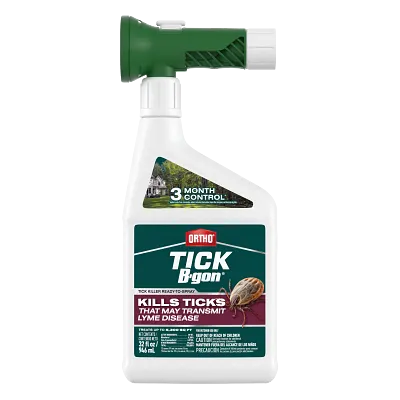
For targeted tick control, a ready-to-spray tick killer product, like Ortho Tick B-Gon, attaches to your garden hose for easy, even coverage to your lawn, landscape, and home foundation. It also starts working within minutes of application. For granular lawn coverage, Ortho BugClear Lawn Insect Killer kills American dog ticks, brown dog ticks, and deer ticks by contact and provides up to 3 months of residual protection. For a 2-in-1 lawn care approach that controls ticks while feeding your grass, Scotts Turf Builder SummerGuard is an option worth considering.
Step 4: Reduce Wildlife Access
Step 5: Protect Your Pets

Look for a fast-acting formula that starts working within minutes, has broad-spectrum control against multiple tick species, and provides long-lasting residual protection (3 months is ideal).
Pet safety matters. Look for label language like "People and pets may enter treated areas after spray has dried" on any spray-based tick control product. Remember: Tick control products for the yard are not intended for use on your pet. Always use vet-recommended tick preventives on your animals.
Yard-Level Prevention
Personal Protection
Pet Protection
Home Protection
Ticks can be a persistent pest, but you don't need to be afraid of them. With the right knowledge and a consistent approach to yard care and personal protection, you and your family can enjoy the outdoors with confidence.

Tick-borne diseases are a growing concern, but effective tick prevention is well within your reach. Combine habitat management with consistent applications of a tick spray for yards starting in early spring, and you'll have real control over tick populations in your outdoor spaces.
Protect your family and pets this season. Start with a yard treatment in March or April and stay consistent with your yard care routine through fall. Ready-to-spray yard insect killers labeled for ticks usually start working within minutes and keep working for up to 3 months, so you can get back to enjoying your yard with confidence.
Most tick species cannot survive indoors. The exception is the brown dog tick, which can complete its entire life cycle inside a home. Thorough cleaning and a perimeter insect barrier around entry points can help keep ticks out.
No. Ticks secrete anesthetic saliva, making bites painless. Regular body checks after outdoor activity are the only reliable way to catch them.
Many species become dormant in cold weather, but blacklegged ticks stay active as long as temperatures stay above freezing. In warmer states, where temperatures stay above 40° in the winter, ticks can be active year-round.
No. Only blacklegged ticks transmit Lyme disease, and not every one carries the bacterium. Transmission typically requires at least 24 to 48 hours of continuous attachment.
Clean the bite with rubbing alcohol or soap and water. Dispose of the tick in alcohol or a sealed bag. Monitor for symptoms for 30 days and contact your healthcare provider if a rash, fever, or joint pain develops.
Ticks cannot bite through most clothing, but they can crawl under loose garments. Tucking pants into socks and wearing permethrin-treated clothing provides an effective barrier.
No. Ticks cannot jump, fly, or drop from trees. They “quest” from ground-level vegetation and climb onto hosts that brush against them.

At Ortho, we promote transparency and clear communication regarding our product formulations. Whether treating indoor or outdoor bugs, we are committed to creating products that meet consumer needs by prioritizing clear labeling and information on our packaging. Our product labels provide clear directions for use as well as precautionary and first-aid information to inform consumers and end-users