




Update Location
Enter a ZIP code to get product recommendations and information tailored to your area.
A grow light is an artificial light source that replaces or supplements natural sunlight for plants growing indoors. Unlike a standard household bulb designed for human vision, a grow light emits the specific wavelengths—especially blue and red—that drive photosynthesis, compact plant development, and fruiting. A plant grow light is calibrated for what your plant sees, not what you do.
How Grow Lights Work
Plants use light within the PAR range — wavelengths from 400 to 700 nanometers — to power photosynthesis. PPFD (Photosynthetic Photon Flux Density) measures how many of those PAR photons actually reach the leaf surface each second, expressed in µmol/m²/s. That's the number that tells you whether a grow light is delivering real energy to your plants — not lumens, which measure brightness the way human eyes perceive it. Within the PAR window, blue wavelengths (400–500 nm) drive compact, leafy growth, while red wavelengths (600–700 nm) trigger flowering and fruiting.
Regular household bulbs are optimized for human visibility, not plant biology. They lack the targeted red and blue spectrum that powers photosynthesis and rarely deliver the intensity (PPFD) needed to sustain real indoor growth. A grow light closes that gap; that's what makes artificial light for plants fundamentally different from the lamp on your desk, and it's why the grow light spectrum and intensity is important, not just brightness.
Types of Grow Lights: LED vs. Fluorescent vs. HID
Why Use Grow Lights? When Natural Light Isn't Enough
Most edible plants need 14–18 hours of bright light daily; a sunny, summer window delivers 4–6 hours (far less in winter). Grow lights are the definitive winter plant light and the foundation of serious indoor gardening lighting. Herbs stretching toward the window or pale new growth are your plants asking for more.
AeroGarden LED grow lights emit a calibrated blend of wavelengths absorbed by chlorophyll to power photosynthesis from germination to harvest. Blue light builds strong, compact foliage; red light signals plants to flower and fruit. Together they replicate the full arc of natural sunlight which is why a white LED grow light from AeroGarden delivers the best light spectrum for plants without any mixing or guesswork.
Understanding Spectrum: Full Spectrum, Red/Blue, and White Light
A full spectrum grow light covers the complete PAR range—blue, green, red, and often UV and infrared—to closely mimic natural sunlight. Red/blue ("blurple") grow lights target only the photosynthetic peaks, while white LED grow lights blend wavelengths for a natural appearance while hitting the grow light color temperature plants need. For most home growers, a full spectrum LED grow light is the clear choice.
| Option | Best For | Coverage |
|---|---|---|
|
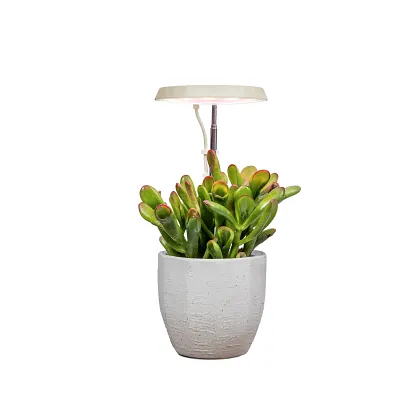
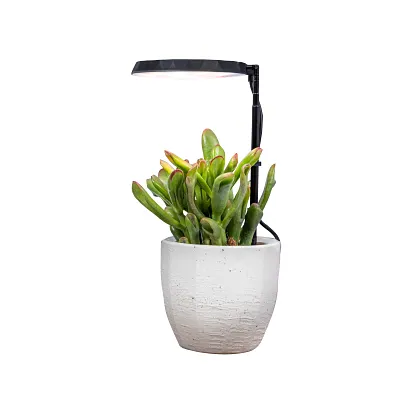
Stem Grow Light |
Single houseplants and grow lights for succulents |
Single adjustable arm |
|
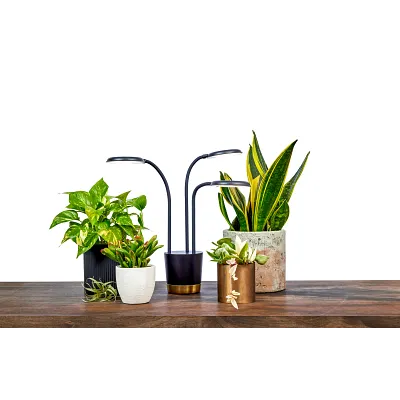
Trio Grow Light |
2–4 houseplants or herb pots |
Three adjustable arms |
How to Choose the Right Grow Light (Coverage, Brightness & Plant Needs)
Match grow light output and coverage area to your plant count and type. Low-light plants need lower PPFD (50–150 μmol/m²/s); fruiting vegetables need 300–600+ μmol/m²/s. The best grow light for indoor plants matches the intensity to the species. When using grow lights for seedlings, run the lights 16–18 hours per day with the lights 2-4 inches above the top of the seedlings. The best grow light for herbs runs 14–16 hours of full spectrum LED keeping basil, cilantro, and mint thriving. For a vegetable grow light indoor setup, higher-wattage systems handle tomatoes and peppers that need real intensity and a consistent photoperiod for plants.
Let automation run the schedule. AeroGarden grow lights include a built-in light timer with automatic on/off cycles to keep your plants on the ideal photoperiod without daily intervention.
Match distance to growth stage. Position your grow light a few inches above seedlings, 12–24 inches above established foliage. Leaves bleaching under grow light? Raise the fixture.
Plants leggy under grow light? Lower it or extend the grow light schedule.
Read your plants, not just the timer. Yellowing lower leaves point to grow light too weak or too few hours. Bleached patches signal grow light too close. Compact, vibrant new growth at a steady pace means everything's dialed in.
Placement & Schedule: How Far, How Long, and When to Run Grow Lights
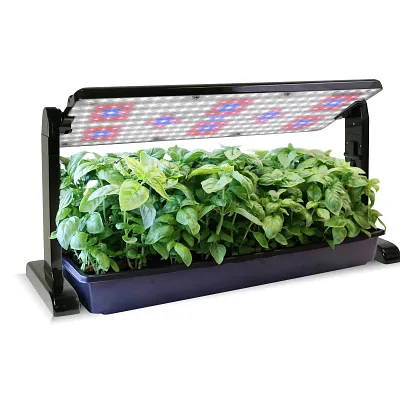
For herbs and leafy greens: 12–16 inches from the light, 14–16 grow light hours per day. For seedlings: 2-6 inches, 16–18 hours. AeroGarden's programmable grow light schedule manages the light cycle, but you adjust the height of the light.
Setup, Safety & Efficiency (Heat, Power Use, Timers, Eye Safety)
AeroGarden LED grow lights produce minimal heat output versus fluorescent or HID alternatives. For grow light safety, avoid prolonged direct eye exposure. AeroGarden grow lights are a genuinely energy efficient grow light: low electricity cost, and fully automated with the built-in grow light timer.
Troubleshooting: Common Grow Light Problems & Fixes
Yes. When matched to your plants' needs, grow lights drive genuine photosynthesis and consistent growth.
A grow light emits the red and blue wavelengths that power plant photosynthesis at intensities (PPFD) sufficient to sustain real growth. That's what makes them genuinely different from a household lamp.
Whenever your plants aren't getting 12–16 hours of strong light daily—including winter months, low-light rooms, or any time you want to supplement sunlight for plants year-round.
Stretched, leggy stems reaching toward the window, pale new leaves, and stalled growth are the clearest indoor plant light problems to watch for.
For home growers, a full spectrum LED grow light is the best grow light type: efficient, cool-running, and effective at every growth stage with no setup complexity.
A full spectrum grow light covers the complete PAR range (400–700 nm)—blue, green, and red—to mimic natural sunlight and support healthy plant development from seedling to harvest.
Too weak: plants stretch and grow slowly. Too close: leaves bleach or curl. Compact, vibrant growth at a steady pace means you've found the sweet spot.