




Update Location
Enter a ZIP code to get product recommendations and information tailored to your area.

Straight answers on traps, bait stations, pets and safety, so you can take back your home fast.
Found droppings in the pantry? Heard scratching in the walls at night? You’ve got questions, and you need answers now. This FAQ covers what people ask us most: how to tell mice from rats, how to set and check traps, how bait stations work, and how to keep kids and pets safe while you deal with the problem.
Key Takeaways
Size is the fastest tell: an adult house mouse is 6 to 7 inches long including its tail and weighs under an ounce, while rats run 12 to 18 inches and up to about a pound. The three most common rodent pests in US homes are the house mouse, the Norway rat and the roof rat.
| House mouse | Norway rat | Roof rat | |
|---|---|---|---|
|
Length (head to tail) |
6-7 in. |
12-18 in. |
13-17 in. |
|
Weight |
About 3/4 oz. |
About 15 oz. |
About 8 oz. |
|
Color |
Dusty gray to black |
Brown to reddish brown |
Dark gray to black |
|
Build |
Small head and body |
Stocky, blunt nose, small ears |
Slender, pointed nose, large ears, long tail |
|
Where in the U.S. |
Nationwide |
Nationwide |
West Coast and Southeast coastal areas |
For more on food preferences, nesting and droppings, see Telltale Signs of a Rodent Infestation.
Droppings are your best gauge: the more fresh droppings you find, and the more places you find them, the larger the population. Also look for greasy rub marks along walls and baseboards where rodents run. If you’ve started trapping or baiting and keep finding fresh droppings or new marks, more rodents are still active, so keep going.
Not far, which is why placement matters so much. House mice usually stay within 10 to 30 feet of their nest. Norway rats typically forage within about 100 to 150 feet and seldom go beyond 300 feet. Roof rats routinely travel up to 300 feet for food. Put traps and bait stations close to where you see signs of activity.
Smaller than you’d think. A house mouse can squeeze through a gap of about ¼ inch, and a young rat can slip under a door with just a ½-inch gap. When you seal your home, close every opening larger than ¼ inch around pipes, vents, utility lines, doors and the foundation, using steel wool, hardware cloth, caulk or weatherstripping.

Rats take cover in dark, quiet, protected places: behind and under appliances, in cupboards, closets and garages, inside walls, in attics, and in woodpiles. Norway rats tend to stay low, in basements, ground floors and burrows along foundations. Roof rats climb, nesting in attics, trees and dense vines, and use branches and utility lines to reach your roof.
A rat eats about 1 ounce of food a day, and a mouse about 1/10 ounce. That’s small per animal, but mice and rats also contaminate far more food than they eat with urine and droppings, so store pantry food and pet food in sealed containers.

House mice usually live less than a year outdoors. Indoors, with steady food and shelter and no predators, they can live longer, sometimes up to 2 years. More important than lifespan is how fast they breed, which is why you should act at the first sign of activity.
Fast, which is why you should act at the first sign of activity. A female house mouse can have 5 to 10 litters a year of about 5 or 6 pups each, and young mice can breed at 5 to 6 weeks old. A female Norway rat averages 4 to 6 litters a year and can raise 20 or more young annually; roof rats average 3 to 5 litters of up to 8.
Size and shape tell you which rodent you’re dealing with. Mouse droppings are about ¼ inch long, roughly the size of a grain of rice. Roof rat droppings are about ½ inch long with pointed ends. Norway rat droppings are about ¾ inch long with blunt ends. All are dark when fresh. Never sweep or vacuum droppings; see How to Get Rid of Mice in Your Home for safe cleanup.

Check kill traps for mice and rats at least once a day, ideally every morning, and dispose of any catch right away. Daily checks prevent odor, keep bait fresh and get traps ready for the next rodent. Check live-catch mouse traps at least twice a day, because a trapped mouse can dehydrate quickly.
| Trap type | How often to check |
|---|---|
|
Snap traps, wooden traps, Kill & Contain |
At least once a day |
|
Glue traps |
At least once a day |
|
Live-catch (single or multi-catch) |
At least twice a day |
|
Bait stations |
Check bait level regularly and keep it stocked as the label directs |
If a mouse trap hasn’t caught anything in a few days, move it to a new spot along a wall where you’ve seen activity. Rats are more cautious of new objects and can take several days or longer to approach a trap, so give rat traps more time before you move them. For live traps, see How Humane Mouse Traps Work.
More than one, even if you’ve only seen a single mouse — there’s rarely just one. Start with at least two traps in each area where you’ve seen droppings or activity, spaced 5 to 10 feet apart along the walls. For a larger infestation, set several traps throughout every active area, keeping the same 5- to 10-foot spacing.
For rats, space traps about 10 to 20 feet apart along walls and runways. A heavy rat problem can take a dozen or more traps.
Use enough traps to get the job done quickly. A trap that goes off without catching a rat can make that rat avoid traps afterward, so it pays to set plenty at once rather than adding them one at a time.
Use the right size trap, too. Mice often won’t trigger a rat trap, and a rat can escape or damage a mouse trap.

It depends on the trap. Some Tomcat traps are built to reset and use again; others are designed for single use, so you toss the whole trap and never touch the rodent. Always check the label before you reset a trap.
| Tomcat trap | Reusable? |
|---|---|
|
Yes. Squeeze the back to release the mouse; the trap resets. |
|
|
Yes. Re-bait the removable cup and set it again after each catch. |
|
|
Usually. Inspect the wood and spring between catches and replace the trap if it’s worn. |
|
|
Yes. Release the mouse, clean the trap, and set it again. |
|
|
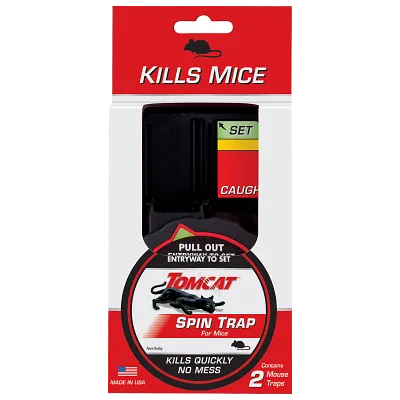
No. Single use: dispose of the entire trap once it shows Mouse Caught. |
|
|
No. Disposable: use the grab tab to throw away the trap and mouse together. |
|
|
No. Single use: use the grab tab to dispose of the entire trap. |
|
|
Wooden Mouse Traps and glue traps |
No. Disposable. |
Single-use traps are designed for no-touch, no-mess disposal, so each one does its job and goes straight in the trash. When you reuse a trap, wear gloves and clean it before you set it again.
Put traps where rodents actually travel, close to droppings, gnaw marks, urine stains or greasy rub marks, and between where they hide and where they feed. Avoid putting traps next to pet food or garbage, which compete with your bait.
Keep all traps out of reach of kids and pets.
Most kill traps work best with bait. Use a small, pea-sized dab of Tomcat Attractant Gel or peanut butter; too much lets a rodent feed without triggering the trap.
Rats are wary of new objects. To keep them from becoming trap-shy, you can bait rat traps and leave them unset until the bait has been taken a few times, then bait and set them.

Bait the trigger with a small amount of Tomcat Attractant Gel or peanut butter. Pull the U-shaped bar back to the opposite end of the trap, then insert the top of the pin into the underside of the trigger to hold it. Place the trap against a wall where you’ve seen activity, keeping your fingers clear of the bar. Once it catches a mouse, throw away the trap and mouse together.
Never touch a dead rodent with bare hands. Germs from its urine and droppings can spread when you handle it, so the CDC recommends disinfecting it before you bag it.
If you have a reusable snap trap, disinfect it before you set it again.
No. Tomcat glue traps already include a scent that attracts rodents, and adding food bait can actually make the trap less effective. Place glue traps flat along walls where you’ve seen activity. If nothing is caught in 2 to 3 days, move the trap to a new spot.
Grip the release paper at one corner and pull it off in one smooth, continuous motion, like removing an adhesive bandage. Pulling slowly or stopping partway makes the paper more likely to tear.

Pull the glue trap away slowly so most of the glue stays on the tray. Then work the residue loose with oil:
Test any cleaner on a hidden spot first. If a pet has glue near its eyes or mouth, or you think it swallowed any, call your veterinarian.
Bromethalin, the active ingredient in Tomcat bait blocks, begins working quickly once a rodent eats it, but rodents typically go back into hiding afterward, so you may not see dead rodents. Don’t judge results by the first day or two. Keep bait stations continuously stocked for as long as the label directs or until you no longer see fresh signs of activity.
It depends on the rodent and how widespread the activity is, and your product label gives the spacing. For example, the Tomcat Rat & Mouse Killer, Child & Dog Resistant, Refillable Station calls for 15 to 30 feet between stations; products made for mice only may call for closer spacing. For larger problems, place stations in every area with activity so you stop the population before it grows. Each label also tells you how many rodents a bait block can kill.

Keep bait blocks inside a bait station, and start as soon as you notice activity. Place stations against walls or in corners where you’ve seen signs. Wear gloves when loading bait, keep bait fresh and dry, and replace bait that’s been eaten or contaminated. Each rodent only needs to eat a small amount, so the bait may be working even if the block looks barely touched. Always follow the label directions.
Yes. Mice squeeze through very small openings, about the size of a dime, so they can easily enter Tomcat bait stations, including stations sized for rats and mice. Make sure the product you choose is labeled for the rodent you’re targeting.
Yes. The US Environmental Protection Agency (EPA) controls the registration and sale of rodent baits. Every registered product must meet requirements for effectiveness and safety, and even the wording on the package is reviewed. State agencies work with the EPA to monitor products for compliance.

Tomcat rodent baits use bromethalin, a fast-acting active ingredient that begins working once a rodent eats it. Unlike many traditional rodenticides, bromethalin is not an anticoagulant. It doesn’t cause bleeding; instead, it’s a neurotoxin that attacks the rodent’s central nervous system.
No, that’s a myth. Eating bait doesn’t change a rodent’s normal need for water, and there’s enough water inside a typical home to meet it. If there weren’t, the rodents wouldn’t be living there. Rodents that eat bait usually die in their hiding spots, which may be inside walls or other hard-to-reach places.

No. Every dead animal goes through natural decomposition, which creates odor, no matter what bait was used. If you notice an odor, it typically fades as decomposition finishes. Trapping lets you remove rodents promptly if odor is a concern.
Use a bait station labeled child- and dog-resistant, such as the Tomcat Rat & Mouse Killer, Child & Dog Resistant, Refillable Station, and follow its label for placement. Even with a resistant station, keep stations away from children, pets and wildlife whenever possible, and store all bait block refills in their original container somewhere kids and dogs can’t reach.
No. Rodent bait is harmful if swallowed by dogs, cats and other pets. Keep bait inside a child- and dog-resistant bait station, follow the label’s placement directions, and store bait block refills where pets can’t get to them.

Act immediately. Call your veterinarian or the number on the product label, 1-877-854-2494, right away, and have the package or label in hand so you can tell them exactly what your dog ate. How serious it is depends on the type and size of the animal, the product and how much was eaten, so don’t wait for symptoms.
Yes, it’s possible but also very uncommon. While dogs, cats and scavenging animals might be poisoned if they eat rodents that have died after consuming bromethalin bait, a rodent will typically metabolize and excrete most of the compound before dying making secondary poisoning from bromethalin rare. Wearing gloves, remove dead rodents promptly, and keep pets from scavenging in areas where you’re baiting. If you’re concerned your pet ate a poisoned rodent, call your veterinarian or 1-877-854-2494.
Call Poison Help at 1-800-222-1222 or the number on the product label, 1-877-854-2494, right away, and have the label with you. If the person is unconscious, having a seizure or having trouble breathing, call 911.
Traps don’t use poison, but any trap can pinch fingers or paws, so place all traps where kids and pets can’t reach them. When activated, rat traps can cause serious physical injury requiring medical attention. Enclosed designs like the Kill & Contain Mouse Trap keep the mechanism and the catch inside. Still, put them behind appliances, inside cabinets or in closed-off rooms.

Tomcat products are sold at retailers across the United States and online. You can also shop the full lineup of Tomcat products directly on our site.
Chat with our virtual agent. It’s available right here on our site and can answer questions about Tomcat products, how to use them and how to handle your rodent problem, so you get an answer without waiting. If your question needs a person, the chat can connect you with a member of our team.
For help with an order, your account or subscriptions, or the No Quibble Guarantee, visit the ScottsMiracle-Gro Help Center.
In an emergency, don’t wait to chat. If a person may have swallowed rodent bait, call Poison Help at 1-800-222-1222 or 1-877-854-2494. If a pet may have, call your veterinarian or 1-877-854-2494.