




Update Location
Enter a ZIP code to get product recommendations and information tailored to your area.

Learn what kind of ants you have, where they’re coming from, and how to get rid of the whole colony with bait, spray, and dust.
A few ants on the counter usually means a colony is nearby, sending scouts out to find food and water. Wiping up the ants you see helps, but it won’t stop the colony from sending more. The most effective way to get rid of ants in your house is to reach the colony with bait first. Once activity slows, spray the places ants hide and enter, then treat around the outside of your home to keep new ants from moving in. Here’s how to do it, plus how to keep your family and pets in mind along the way.
Key Takeaways
Hundreds of ant species live in the US, but only a handful regularly come indoors. Most house ants are small foragers looking for sweets, grease, or water. Knowing which ant you have matters, because some, like carpenter ants and fire ants, need a different approach.
You can tell an ant from other insects by its three-part body (head, thorax, and abdomen), narrow waist, and elbowed antennae. Winged ants are sometimes mistaken for termites; ants have a pinched waist and bent antennae, while termites have a thick waist and straight antennae.
| Ant species | What it looks like | Where you'll usually see it | Controlled by Ortho Orthene Ant Killer Ant Bait? |
|---|---|---|---|
|
Odorous house ant |
Small, brown to black; smells like rotten coconut when crushed |
Kitchens, near sweets and moisture |
Yes |
|
Pavement ant |
Small, dark brown to black |
Ground floors and basements, coming up through slab cracks |
Yes |
|
Pharaoh ant |
Tiny, yellowish to light brown |
Warm spots near food and water, often inside walls |
Yes |
|
Little black ant |
Tiny, shiny black |
Kitchens, along baseboards and windowsills |
Yes |
|
Carpenter ant |
Large, black or reddish black |
Near damp or damaged wood; may leave sawdust-like debris |
No, see FAQ |
|
Fire Ant |
Small to medium, reddish brown |
Outdoor mounds, mostly in the South; painful sting |
No, see FAQ |

For more help identifying ants, see How to Identify & Control Different Types of Ants.
Ants in the house come from a colony nesting nearby: in the soil outside, under a cement slab or sidewalk, or sometimes inside walls or behind baseboards. A colony can range from a few hundred to many thousands of ants, with one or more queens laying eggs and workers that forage for food.
The first ants you notice are usually scouts. When they find food or water, they leave a scent trail, and others follow it. That’s why one ant often turns into a line of them. Ants are most likely to come inside in spring, when they become active again after winter and look for food, and in fall, when they look for shelter.
Swarms of winged ants outside your house are usually mating flights. But winged ants indoors can mean a colony is nesting inside, so look for where they’re coming from.
The most obvious sign of an ant infestation is a trail of ants on counters, floors, or walls, usually leading to food or water. You’ll most often find them in kitchens and pantries, but bathrooms and laundry rooms attract them too because of the moisture.
Other signs to watch for:
Treat ants as soon as you notice them. Colonies grow over time, ants can contaminate food, carpenter ants can damage wood, and fire ants can stings.

The most effective way to get rid of ants in your house is to reach the colony, not just the ants you see. Start with bait stations to kill the queen and the colony. Once activity slows, spray indoor hiding spots and entry points. Then treat your home’s outdoor perimeter to keep new ants from coming in.
Library of Terms
Ant bait station: an enclosed station holding food mixed with a slow-acting insecticide. Worker ants carry the bait back to the nest and share it, so it reaches the queen and the rest of the colony.
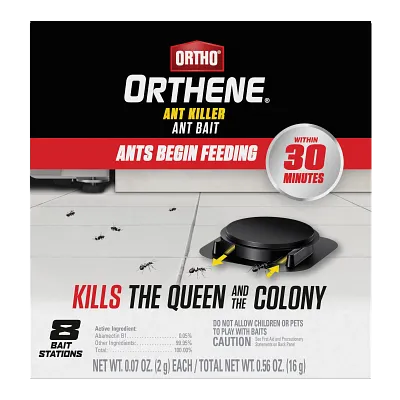
Ortho Orthene Ant Killer Ant Bait kills the queen and the colony. Ants begin feeding within 30 minutes, carry the bait back to the nest, and share it. You’ll see fewer ants in 3 to 7 days.
Seeing more ants around the stations at first is a good sign: they’re taking the bait back to the colony. Let them.

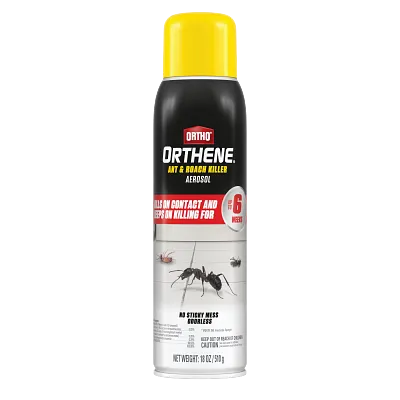
Give the bait time to work before you spray. Once you’re seeing fewer ants, usually 3 to 7 days after setting out stations, treat the places ants hide and come in with Ortho Orthene Ant & Roach Killer Aerosol. It kills ants on contact and keeps killing for up to 6 weeks. The formula is odorless and doesn’t leave a sticky mess.

Many house ants nest outside and come in through small gaps. To stop them before they reach the door, apply Ortho Orthene Ant & Roach Killer dust around the outside of your home. It kills listed insects, including ants, for up to 8 months. It’s odorless and doesn’t need to be watered in.
Apply around windows, doors, porches, patios, garages, and under stairways where ants are active.
Apply thoroughly and evenly along the foundation and crawl space openings where ants may find a way in.

Ortho Orthene ant control products can be used in homes with kids and pets when you follow the label directions. Bait stations rely on placement: put them where kids and pets can’t get to them. Sprays rely on timing: keep kids and pets out until the spray has dried. Outdoor dust relies on timing, too: keep kids and pets away while you apply it and until it has settled.
| Product | Kids and Pets | Before you use it | Where to place or apply it |
|---|---|---|---|
|
Ortho Orthene Ant Killer Ant Bait |
Stations can stay in place while your family uses the room, but don’t let kids or pets play with them |
Break stations apart. Don’t place on food-prep surfaces while preparing food. |
Where ants travel but kids and pets can’t reach, such as behind appliances, under sinks, inside cabinets, and along baseboards behind furniture |
|
Ortho Orthene Ant & Roach Killer Aerosol |
Keep them out until the spray has completely dried |
Move kids, pets, and birds out of the room, and cover fish tanks. Remove or cover exposed food, drinking water, pet bowls, dishes, and utensils. |
Indoors as a spot treatment in hiding spots and entry points, away from bait stations |
|
Ortho Orthene Ant & Roach Killer (dust) |
Keep them away while you apply, and let the dust settle before they return to the area |
Apply in calm weather when rain isn’t expected for 24 hours. Don’t use kitchen spoons or measuring cups to apply it. |
Outdoors around doors, windows, porches, patios, and garages, and along the foundation. Keep it out of storm drains, gutters, and drainage ditches. |
A few additional good habits help:
Every Ortho label lists its active ingredients so you know what you’re using: abamectin B1 in Orthene Ant Killer Ant Bait; prallethrin and esfenvalerate in Orthene Ant & Roach Killer Aerosol; and deltamethrin in Orthene Ant & Roach Killer dust.
The best way to keep ants out is to take away the food, water, and openings that drew them in, and to replace bait stations as soon as the bait runs out.

Ants begin feeding on Ortho Orthene Ant Killer Ant Bait within 30 minutes, and you should see fewer ants in 3 to 7 days as the bait is spread through the colony. Leave the stations in place and replace them once most of the bait is gone, or every 3 months.
Yes, but time it and keep them apart. Give the bait 3 to 7 days to reach the colony first, since ants killed on the trail can’t carry bait back to the nest. Once activity slows, spray hiding spots and entry points, keeping the spray away from any stations still in place; ants may avoid bait stations if they’re place where insecticide has recently been sprayed.
Home remedies like vinegar, cinnamon, or citrus peels may disrupt ant scent trails or keep ants away from a spot for a while, but they don’t kill the colony, so ants usually return. They can also steer ants away from bait stations. For lasting results, use bait to reach the colony, and use soapy water to clean up trails in areas where you haven’t placed bait.
Carpenter ants and fire ants aren’t controlled by Ortho Orthene Ant Killer Ant Bait. For carpenter ants, Ortho Orthene Ant & Roach Killer dust can be applied into voids and channels in damaged wood. Because carpenter ants nest in damp or damaged wood, it’s also a good idea to have a professional inspect for structural damage. For fire ants outdoors, evenly sprinkle 1 tablespoon of the dust over the top of each mound when temperatures are between 65 and 80°F, without watering it in or disturbing the mound. Allow 3 to 4 days for maximum control, then repeat as needed.
Ants usually come back because the colony is still alive, or because food, water, or an easy way in is still available. Spraying only kills the ants you see, while the colony keeps sending more. Bait stations reach the queen and the colony, an outdoor perimeter treatment stops new ants before they get inside, and sealing entry points, cleaning up food sources, and replacing bait every 3 months help keep them from moving back in. For other indoor pests, see How to Get Rid of Bugs Indoors.