




Update Location
Enter a ZIP code to get product recommendations and information tailored to your area.

Learn why bugs move in, how to make your home less inviting, and how to set up a barrier that keeps them out for months.
Bugs like a comfortable home for the same reasons you do: food, water, and shelter. When they find all three inside, ants, cockroaches, spiders, silverfish, and other common house bugs settle in. The good news is that a few simple habits, plus a long-lasting indoor barrier, can take bugs off your counters and off your mind.
Key Takeaways
In this article
Bugs come indoors to find food, water, and shelter. A few crumbs under the toaster, a slow drip under the sink, or a quiet stack of cardboard in the basement can be all it takes. The bugs most often found inside homes include ants, cockroaches, earwigs, firebrats, flies, house centipedes, silverfish, and spiders, and pet owners sometimes deal with fleas and ticks, too.
Which bugs you see depends on the season and where you live. Some show up in spring as the weather warms, while others look for a sheltered spot as fall temperatures drop.

The most effective way to keep bugs out is to make your home harder to enter and less rewarding once they’re inside. That means sealing entry points, storing food tightly, fixing moisture problems, and cutting down on clutter. None of these steps takes long, and together they remove most of what draws bugs indoors in the first place.
Tiny gaps around doors and torn window screens work like open invitations. Check screens, windows, doors, and the spots where pipes and wires enter your home.
You’re not the only one looking for a late-night snack. Pantry bugs go after flour, cereal, baking mixes, crackers, dried pasta, dried fruit, nuts, popcorn, and even spices. Ants go for anything sweet, Indianmeal moths favor grains and nuts, and flour beetles will eat almost anything in a dry-goods cabinet.
Bugs need water as much as food, and some, like silverfish, springtails, and house centipedes, prefer damp spaces.
Regular housekeeping takes away the crumbs and hiding places bugs depend on, especially in the kitchen.
Firewood, compost bins, and yard waste make great hiding places for bugs that later wander inside.
Treat bugs as soon as you notice them, because a few bugs are much easier to manage than an established population. Start by identifying what you’re seeing, since the right approach depends on the pest. Then pair cleanup with a product labeled for that bug, such as a bait for ants or a ready-to-use spray for crawling insects. Always follow the label directions.
The Ortho Home Defense line includes baits, aerosols, and ready-to-use sprays, so you can match the product to the problem. If you’re not sure which bug you have, the Common House Bugs section below links to guides for each one.
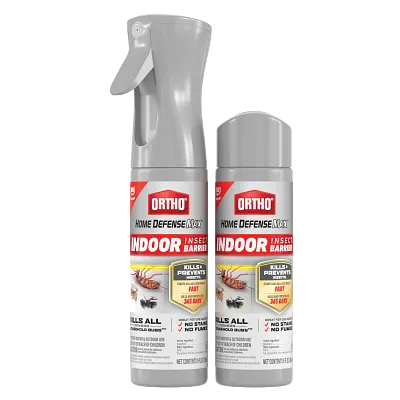
A bug barrier is a band of insect control applied where bugs enter and travel, so they contact it on the way in. Apply it along baseboards, around doors and windows, and in the cracks where bugs hide. Ortho Home Defense Max Indoor Insect Barrier kills and prevents ants, roaches, and spiders for up to 12 months indoors on non-porous surfaces.
For best results:
The same product can also be applied as a band around your home’s exterior foundation. Outdoors, plan to reapply about every 3 months.

Bug Control Terms
Bug barrier: a band of insect control applied along entry points and travel paths so that bugs crossing it are killed, helping prevent new ones from settling in.
Non-porous surface: a hard, sealed surface that doesn’t soak up liquid, like vinyl baseboards, sealed tile, or painted trim. The 12-month protection claim applies to these surfaces.
Indoor bug sprays like Ortho Home Defense can be used in homes with kids and pets when you follow the label directions. The product label is your most important guide: it tells you where to apply, how to apply, when your family can return to the treated area, and how to store the product.
Kids and pets can go back into a treated area once the spray has completely dried. Keep them out of the room, in another part of the house, while you apply. Drying time depends on temperature, humidity, airflow, and the surface, so check that the treated areas are completely dry before anyone returns. Opening a window can help speed up drying time.
Before you spray, cover or remove any exposed food, dishes, and food-prep equipment. Pick up toys, pet food and water bowls, and anything else small hands or paws might touch. Apply only where the label directs, such as a band along baseboards and into cracks and crevices. After the spray dries, wash food-prep surfaces and utensils with soap and water before using them.

Never spray pets with an indoor bug spray. These products are made for surfaces like baseboards and cracks, not for animals. If your dog or cat has fleas or ticks, use a veterinarian-approved product registered for use on pets, and ask your veterinarian which one is right for your animal.
Store bug spray in its original container, properly closed, in a cool, dry place out of reach of children and pets, such as a high or locked cabinet. If your sprayer has an on/off knob or nozzle, turn it to “OFF” before you put it away.

Ortho develops its bug control products to be effective, easy to use, and safe when used as directed. Every formulation goes through staged testing against specific criteria, and active ingredients are reviewed regularly for safety, effectiveness, and environmental impact using a science-based review process. Safety to people and animals is part of the formulation criteria, and detailed labels explain exactly where and how to use each product. Every label also lists the active ingredient (for example: bifenthrin, in Ortho Home Defense Max Indoor Insect Barrier), so you always know what you’re using.
The most common house bugs are ants, cockroaches, earwigs, flies, house centipedes, silverfish, stink bugs, and spiders. Each has its own habits and preferred hiding places in your home, so knowing which one you’re dealing with points you toward the right fix. Here’s a quick guide, with links to a more in-depth article on each.
Ants are expert scavengers, and they’re quick to find any food that isn’t sealed. Once one finds a crumb, it leaves a scent trail for others to follow. Learn more in How to Get Rid of Ants in the Kitchen.
Cockroaches look for warmth, moisture, and food, and even a spotless home can attract them. They hide in tight, dark spaces during the day and come out at night. See our guide on How to Get Rid of Cockroaches.
Earwigs look more intimidating than they are. They usually wander inside by accident, since they prefer to feed on plants and other insects outdoors. Read How to Kill, Control and Prevent Earwigs.
House flies are drawn to food scraps and garbage, and they can carry germs from one surface to another. Learn more in How to Kill House Flies.
House centipedes move fast on long legs, which can be startling, but they actually hunt other household insects. They like damp basements and bathrooms. Learn how to control and prevent centipedes.
Silverfish are thin, silvery insects with three tail-like bristles, most active at night. They like damp areas and feed on starches, including paper and book bindings. See our guide to killing, controlling, and preventing silverfish.
Stink bugs prefer plants to pantry food, but they often move indoors in fall looking for a sheltered place to spend the winter. Learn more on how to keep stink bugs out of your home.
Spiders are valuable in the garden because they eat insects that damage plants. Inside, though, most people would rather not share the space. Learn how to keep spiders out of your home.
Ortho Home Defense Max Indoor Insect Barrier and Ortho Home Defense Insect Killer for Indoor & Perimeter are formulated with no fumes, and both dry clear and dry fast. Home Defense Max Indoor Insect Barrier dries up to 30% faster than other Ortho formulas and won’t stain listed surfaces when used as directed.
If you’re sensitive to odors, open a window while you apply and always let the area dry before using the room. It’s also a good idea to test the spray on a small, hidden spot first.
Ortho Home Defense Max Indoor Insect Barrier kills and prevents ants, roaches, and spiders for up to 12 months indoors on non-porous surfaces. For other listed pests, reapply when you see new activity. The 12-month protection doesn’t extend to porous surfaces or outdoor use; outdoors, reapply about every 3 months.
Seeing bugs for a while after spraying is common, and it usually doesn't mean the treatment isn't working. An insect barrier kills bugs as they cross treated surfaces, so results improve as more bugs come into contact with it. These are the most common reasons you may still see activity:
General indoor barrier sprays like Ortho Home Defense Max Indoor Insect Barrier aren’t labeled for bed bugs. Bed bugs hide in mattress seams, furniture, and other spots close to where people sleep, and they need a targeted approach. Learn more in How to Get Rid of Bed Bugs.