




Update Location
Enter a ZIP code to get product recommendations and information tailored to your area.

Every lawn is different, and so is every beginner’s starting point. Maybe you just moved in, maybe you’ve mowed your lawn for years but never fed or seeded anything. Either way, you really only need to answer three questions to know what to buy: does your lawn need feeding, does it need to be seeded, and what will you use to apply the product to your lawn? Here’s how to figure out all three, with links to the full how-to for whichever applies to you.
At minimum, most lawns benefit from regular fertilizer. Beyond that, whether you need grass seed depends on your lawn’s condition (bare spots, thinning, or a complete do-over is needed), and whether you need a spreader depends on how much lawn you have. Following label directions matters for good results and for keeping products safe around family and pets. Scotts products are formulated to meet strict safety standards, so a lawn fed with Turf Builder Lawn Food is safe for kids to play on right after it’s applied if you follow label directions.
How Often Should I Feed My Lawn?
Aim for at least four feedings per year, spaced roughly 6–8 weeks apart. A lawn fed on that schedule grows thicker and greener, develops deeper roots, resists weeds better, and holds up to heat, drought, and foot traffic better than one left to fend for itself. For the fundamentals of how fertilizer actually works—what those N-P-K numbers mean and why timing matters—see Lawn Fertilizers: What You Need to Know.
Does It Matter What Season It Is?
Yes. What you feed your lawn changes with the season and where you live. To learn what lawn care product to use for each season see our guide: When to Fertilize for a Greener Lawn. It covers the full year lawn fertilizer schedule.
What If I Just Want to Deal With Weeds?
Not every homeowner wants, or needs, a fertilizer-plus-control combination product. If you’d rather treat your whole lawn in one pass, a weed and feed product, like Turf Builder Weed & Feed or Bonus S Southern Weed & Feed, handles the lawn feeding and the weed control together. If you’ve just got a few stubborn weeds and don’t want to treat the rest of the lawn, a targeted ready-to-use, like Ortho WeedClear Weed Killer for Lawns, lets you spot-treat instead. Neither approach is objectively better; it depends on whether you’re dealing with a lawn-wide weed problem or just a few holdouts.


If you want to know what lawn weeds you’re dealing with, our Guide to 7 Common Lawn Weeds identifies the most common culprits.
Which of these sounds like your lawn?
My Lawn Has Bare Spots
That’s a patching job, not a full reseed. How to Repair a Lawn & Seed Bare Patches walks through it step by step.
My Lawn Is Thin, Not Bare
That’s overseeding—adding seed into a lawn that’s okay but sparse. How to Overseed a Thin Lawn covers the technique.
I’m Starting a Brand-New Lawn
That’s a full reseed or renovation, and it’s a bigger project than the other two. How to Reseed a Lawn covers the complete process from bare dirt to established lawn.
When Should I Plant?
Cool-season grasses germinate best between 60–80°F, which usually means spring or fall. Warm-season grasses prefer 75–90°F, so late spring into early summer is your window.


Need help identifying your lawn’s grass type? See Different Types of Grass for a breakdown of cool-season and warm-season grass types.
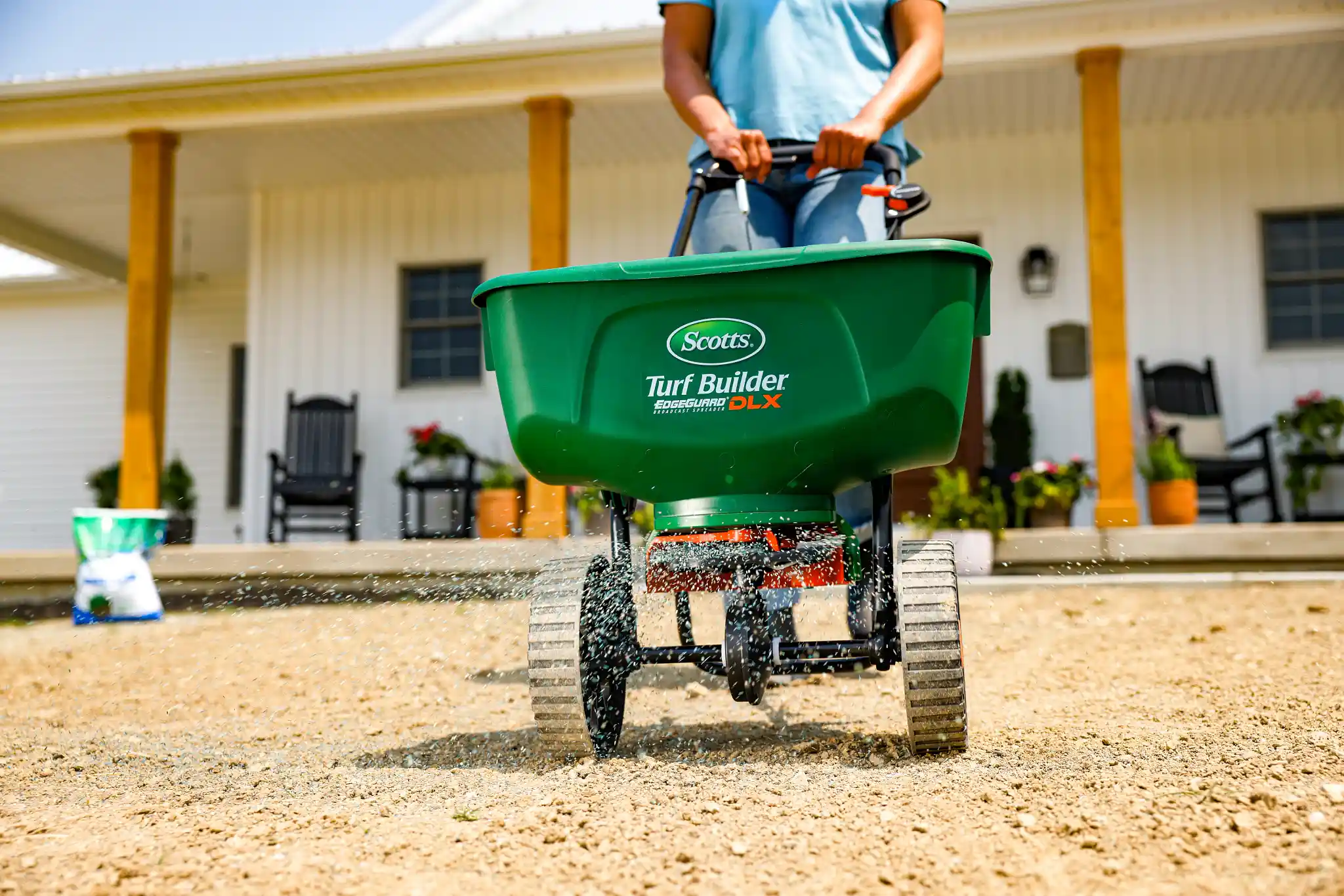
If you’re covering more than a small bare patch, yes. With the exception of a bare-spot repair product, like EZ Seed Patch & Repair, hand-scattering fertilizer or grass seed leads to uneven results. The spreader you need mainly comes down to your lawn’s size and shape. See How to Choose the Right Spreader for Your Yard for a full breakdown by size, plus how to use it once you’ve picked one.


Already have a spreader and just need to confirm your setting? Use the Spreader Settings Lookup Tool to find the right dial setting for your product and spreader.
Fertilizer feeds the grass you already have. Weed control targets unwanted plants, either alongside feeding (weed & feed) or on its own (a targeted killer). Grass seed adds new grass where you don’t have enough. Most lawns need fertilizer regularly; seed and weed control are situational.
A spreader gives you more even coverage than hand-scattering, and it’s the only way to get an accurate application rate for most granular products, especially control products.
If the grass you have looks thin, pale, or patchy but is still there, fertilizer alone may fix it. If you’ve got true bare dirt or a lawn that’s more weeds than grass, you’ll need grass seed too.
Start with applying fertilizer on a regular schedule (every 6-8 weeks), since that’s the foundation almost every lawn needs. From there, look at your lawn’s condition to decide whether seed is also needed.
It depends on the fertilizer you’re using. For basic granular lawn fertilizers, like Turf Builder Lawn Food, the lawn is safe to be on immediately after application. A combination product, like a granular weed and feed, may have different reentry restrictions. Always follow the directions on the product label for reentry timing. For liquid products, both lawn fertilizers and controls, keep kids and pets off the lawn until the spray has dried.