




Update Location
Enter a ZIP code to get product recommendations and information tailored to your area.

Try our NEW Backyard Builder
Discover products tailored to your area in an interactive virtual backyard.
Lawn weed control is the practice of managing unwanted plants—broadleaf weeds, grassy weeds, and sedges—that compete with your turfgrass for water, nutrients, and sunlight. Products range from selective herbicides that kill weeds not grass to pre-emergent barriers that stop weed seeds from sprouting. Effective weed identification and the right product choice are the foundation of a healthy, dense lawn.
Lawn weeds fall into three main categories:
Knowing which type you have determines whether you need a broadleaf weed killer, a crabgrass preventer, or a combination product.
Weed killers (post-emergent herbicides) and weed preventers (pre-emergent herbicides) solve different problems. A weed killer targets weeds that are already growing and visible in your lawn, while a weed preventer creates a soil barrier that stops weed seeds from germinating before they ever emerge. For the best results, use a crabgrass preventer in early spring, then follow up with a broadleaf weed killer later in the season to handle any stragglers that slip through.
Pre-emergent herbicides must be applied before weed seeds sprout; timing is critical, and application too late in the season will miss the window. Post-emergent herbicides work on actively growing weeds and are applied directly to visible plant growth.
The key is choosing a selective herbicide—one formulated to target specific weed types while leaving desirable turfgrass unharmed. Scotts weed control products are labeled for use on named grass varieties, so always check the product label to confirm it's safe for your lawn type before applying.
Post-emergent herbicides are absorbed through weed foliage and travel to the root system, disrupting the plant's growth hormones or metabolic processes until the weed dies. Systemic formulas like weed and feed products move through the entire plant—roots included—so even deep-rooted weeds like dandelions can't regenerate. Pre-emergent herbicides, by contrast, bind to soil particles and form a chemical barrier that prevents germinating seeds from developing into seedlings.
| Product Type | Best For | Apply Every |
|---|---|---|
|
Pre-emergent (granular) |
Stopping crabgrass & annual grassy weeds before they sprout |
Once in early spring (and optionally in fall) |
|
Broadleaf lawn weed killer (liquid) |
Killing dandelions, clover & other broadleaf weeds already growing |
1-2 times per season, when weeds are active |
|
Weed & Feed (granular) |
Feeding the lawn while controlling broadleaf weeds |
1–2 times per season |
|
Spot treatment spray |
Treating isolated weed patches without affecting the whole lawn |
As needed, targeted application |
|
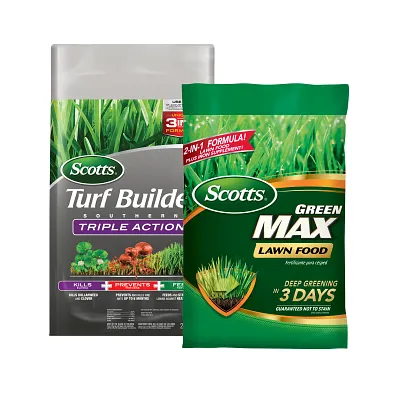
Triple-action formula |
Killing weeds, preventing crabgrass, and feeding grass simultaneously |
Once in spring |
If weeds are scattered in isolated patches, spot treating weeds is the most efficient approach, use a ready-to-use spray to hit individual plants without applying product to the entire lawn. Broadcast treatment (spreading granular or liquid product over the whole lawn) makes sense when weeds are widespread or when you're applying a pre-emergent to create season-wide protection. When in doubt, spot treat first and broadcast only if the problem covers more than 50% of the lawn.
Follow label timing for pre-emergents: Apply your crabgrass preventer when soil temperatures reach 50–55°F in spring. Miss this window and pre-emergent products lose their effectiveness.
Apply when weeds are actively growing: For post-emergent products, weeds absorb herbicides best when they're actively growing and temperatures are between 65°F and 85°F. Avoid applying in extreme heat or drought, which causes weeds to shut down and reduces uptake.
Don't mow too soon before or after application: Mowing right before applying a weed killer limits effectiveness by removing valuable leaf area where the herbicide can be absorbed. After applying, wait at least 24–48 hours before mowing so the herbicide has time to move through the plant.
Spring is the prime window for weed and feed; apply when weeds are small and actively growing for maximum absorption. When to apply weed and feed in fall depends on your region: a fall application feeds roots for winter hardiness while targeting cool-season weeds like poa annua. Always apply to a moist lawn (dew or recent rain) so granules stick to weed leaves.
A weed preventer (pre-emergent) stops weed seeds from sprouting by creating a barrier in the soil, while a weed killer (post-emergent) targets weeds that are already actively growing above the soil surface. You need to use them at different times: a preventer goes down before weeds appear, and a killer is applied once you can see the weeds.
Scotts selective herbicides are formulated to target specific weed species while leaving common turfgrasses unharmed. The active ingredients disrupt processes unique to broadleaf weeds; your grass doesn't share those same vulnerabilities, so it stays healthy while the weeds die off.
Early morning or late afternoon is ideal for spraying weeds—temperatures are moderate, wind speeds are typically lower, and the herbicide is less likely to evaporate before being absorbed. Avoid applying mid-day or when temperatures exceed 85°F, as heat stress causes weeds to close their stomata, reducing herbicide uptake.
For post-emergent products, wait at least 24–48 hours before mowing so the herbicide can fully penetrate the weed. Some systemic products recommend waiting 3–5 days for best results. Mowing too soon removes treated leaf tissue before the chemical reaches the root, reducing effectiveness.
No. Most post-emergent herbicides and all pre-emergent products require a waiting period before seeding. Pre-emergent herbicides prevent germination and will stop grass seed from sprouting just as effectively as weed seed. Check the specific product label, but typically you should wait several months after applying a pre-emergent before seeding, and 2–4 weeks after a post-emergent broadleaf killer.