




Update Location
Enter a ZIP code to get product recommendations and information tailored to your area.
Rat control is the systematic process of eliminating active rat infestations, cutting off entry points, and deterring future invasions. Effective DIY rat control combines control tools, rat exclusion techniques, and repellents to ensure rodents are gone for good. Signs of rats include droppings, gnaw marks, grease trails along walls, and nighttime scratching sounds—all signals that the problem is established and demands immediate action.
Knowing your enemy is the first step to defeating it. Roof rats are slender, agile climbers with long tails and pointed snouts—rodents in attic spaces and ceilings are almost always this species. Norway rats are larger, heavier-bodied burrowers with blunt snouts that favor basements, crawl spaces, and yard burrows. Rat droppings identification is the fastest confirmation: roof rat droppings are small and spindle-shaped (about ½ inch); Norway rat droppings are larger and capsule-shaped (about ¾ inch). Your roof rat treatment or Norway rat extermination strategy may differ in trap placement, but the products that win are the same.
Many homeowners debate whether to handle rat control themselves or call a professional exterminator. The reality: most rat infestations are fully manageable with the right products and approach. Professional exterminators use the same core methods—traps, bait stations, and exclusion—that you can deploy today. Tomcat's lineup delivers professional-grade results without the wait or the cost, so you can start eliminating rats the moment you confirm the problem.
Rat control works by disrupting every stage of a rat's presence: killing existing rodents, removing attractants, and blocking future entry. Snap traps and bait stations eliminate active rats quickly, while rodent repellents create a deterrent barrier that makes your home inhospitable. When paired with rat exclusion measures, you eliminate the conditions that allowed the infestation to take hold—turning a reactive fix into a permanent solution.
| Solution | Best For | Deploy When |
|---|---|---|
|
Bait Stations (Refillable) |
Ongoing or heavy infestations |
Multiple signs of rats; long-term perimeter defense |
|
Disposable Bait Stations |
Quick setup with no mess |
Single-room infestations; rental properties |
|
Snap Traps |
Fast, targeted kills in high-traffic zones |
Attics, along walls, behind appliances |
|
Glue Traps (Rat Size) |
Monitoring and catching in tight spaces |
Garages, storage areas, supplemental coverage |
|
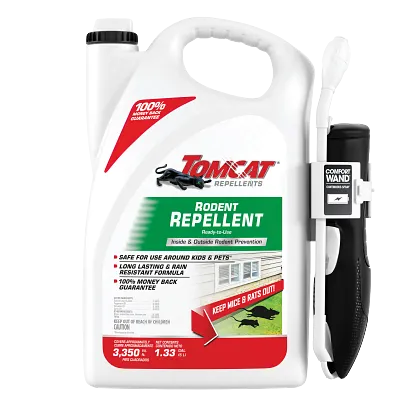
Rodent Repellents |
Prevention and deterrence |
Post-infestation; how to deter rats long-term |
The fastest way to eliminate a severe rat infestation is a layered attack: bait stations at entry points, snap traps along interior travel routes, and repellent along the exterior perimeter. Rats are intelligent—hitting multiple angles simultaneously overwhelms their avoidance instincts and delivers results faster than any single tool.
Place traps along travel routes, not in the open. Rats hug walls—position traps perpendicular to baseboards with the trigger end touching the wall for maximum catch rates.
Check and maintain stations daily. Bait stations and traps only work when they're active. Inspect daily for the first two weeks, remove eliminated rodents promptly, and refresh bait as needed.
Rat exclusion is the step most homeowners skip, and it's why infestations return. Rats squeeze through gaps as small as ½ inch. Inspect your foundation, roof eaves, utility pipe penetrations, and vents. Seal openings with steel wool, hardware cloth, or metal mesh; rats chew through foam and wood. Eliminating every entry point is what turns a short-term fix into permanent rat control.
It is safe to clean up rat droppings yourself—with the right precautions. Ventilate the area for 30 minutes, wear rubber gloves and an N95 mask, and spray droppings with a bleach-water solution (1 part bleach, 10 parts water) before wiping up. Never sweep or vacuum dry droppings, as this launches harmful particles airborne. Double-bag all waste and wash hands thoroughly when finished.
Rat droppings are much larger than mouse droppings—¾ inch for Norway rats and ½ inch for roof rats versus ¼ inch for mice. Rats also leave gnaw marks larger than a quarter-inch, grease smear trails along walls, and heavier thumping sounds in the walls at night.
Set snap traps along rafters and wall edges, then seal every gap larger than ½ inch with steel wool or hardware cloth once activity stops. Apply Tomcat Repellent along the exterior perimeter to deter re-entry.
A simultaneous multi-point attack: refillable bait stations at entry points, snap traps along interior wall edges, and glue traps as monitors. Check daily—most infestations respond within one to two weeks when all pressure points are hit at once.
Inspect where pipes and utilities enter the home, foundation cracks, gaps around garage doors, and roof eaves. Any gap two fingers wide is large enough for a rat. Seal with steel wool packed tightly and covered with hardware cloth or caulk.
Yes—with proper precautions. Wear an N95 mask and rubber gloves, wet droppings with a bleach-water disinfectant before wiping up, and never sweep or vacuum dry droppings. Bag all materials, dispose of immediately, and wash your hands thoroughly afterward.
Secure garbage in sealed bins, eliminate outdoor food sources, and apply Tomcat Rodent Repellent at entry points and around the perimeter. Trim vegetation from the roofline and inspect your exterior twice a year for new gaps.