




Update Location
Enter a ZIP code to get product recommendations and information tailored to your area.

Grab your spreader and about 20 minutes. Here's how to feed your lawn the right way, when the family can get back on the grass, and what to do with the leftovers.
Feeding your lawn is one of the easiest, biggest-payoff jobs in the yard. If you can push a mower, you can fertilize, and a typical subdivision lawn takes less than 20 minutes. The secret isn't muscle. It's reading the bag, setting your spreader right, and walking a smart pattern. Below is the whole routine, start to finish, plus the two questions we hear most once the spreader is parked: When can the kids and the dog get back out there? And what do you do with the half bag in the garage?
Key Takeaways
In this article
You need three things: a lawn fertilizer that fits your grass and the season, a lawn spreader (or a hose if you're using a liquid lawn food), and the product label. Think of the label as your instruction manual. It lists the spreader setting, how much lawn the package covers, the right weather and lawn conditions, and when kids and pets can go back on the grass. Every product is different, so give it a quick read before each application, even if you've used that product before.
Lawn Library
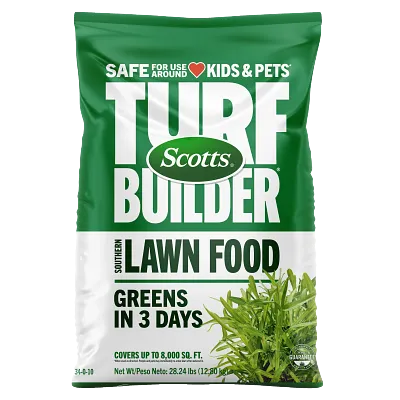
Lawn fertilizer (also called lawn food): a blend of nutrients, mainly nitrogen (N), phosphorus (P), and potassium (K), that supplements what your soil naturally gives your grass. The three numbers on the bag show the percentage of each. A bag labeled 32-0-10, for example, is 32% nitrogen, 0% phosphorus, and 10% potassium.
Here's your short checklist:
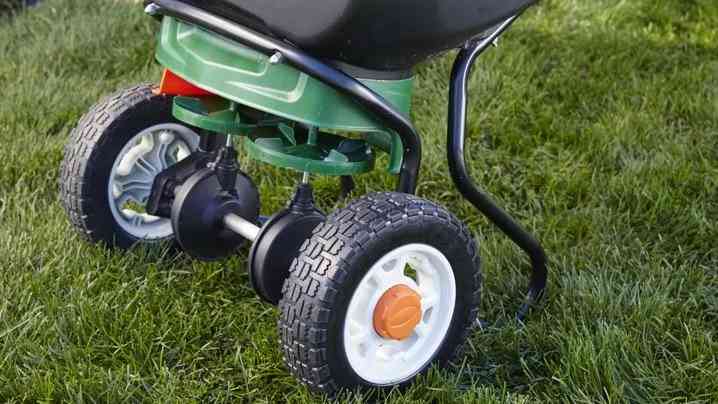
For most lawns, a broadcast spreader is the best choice. It flings granules in a wide arc, so you cover ground quickly and evenly. A drop spreader releases granules straight down between its wheels, which is slower but more precise, making it handy for narrow lawns or lawns with lots of landscaping. A handheld spreader works for small patches. Do not apply products by hand. It's nearly impossible to get even coverage, and uneven coverage means streaks and burned spots.
| Spreader Type | Best for | Good to know |
|---|---|---|
|
Broadcast (Rotary) |
Medium to large lawns |
Covers ground fastest. Models with a side shield that block one side of the spray so you can feed along edges cleanly. |
|
Drop |
Narrow green strips or lawns with a lot of landscaping |
Very precise, but takes more passes. Overlap your wheel tracks to avoid stripes. |
|
Handheld |
Small lawns or areas needing patching |
Keep a steady pace and steady cranking for even coverage. |

For a side-by-side look at the different spreader options, see Which Spreader Is Best for Your Yard?
Fertilize when your grass is actively growing, and space feedings about 6 to 8 weeks apart through the growing season. For cool-season grasses, that's mostly spring and fall. For warm-season grasses, it's late spring through summer. On application day, aim for temperatures within the range on the label (many Scotts lawn foods call for 60°F to 90°F), and skip it if your grass is dormant, frozen, or brown from drought.
Check the forecast, too. A light rain after many lawn food products is no problem, but a downpour can wash granules off your lawn before they do their job. For a season-by-season plan, see When to Fertilize for a Greener Lawn.
Set your spreader to the setting on the product label, then fill it on a hard surface where spills are easy to sweep up. Feed the outer edge of your lawn first, then fill in the middle with straight, back-and-forth passes that slightly overlap, just like mowing. Sweep stray granules back onto the grass, and water the lawn afterward if the label says to. Here's each step in a little more detail.
Before you fill the spreader, read the directions for the product you're using. Two things change from product to product:
Giving your lawn a good watering a few days ahead helps, too. The soil will be moist, but the grass blades will be dry by application day.
Find the setting for your spreader model on the package. Every product has its own setting, so don't assume the setting you used last season still applies. If you need help figuring out your spreader setting, use the Spreader Settings Lookup Tool. Close the hopper, then fill it on a driveway, sidewalk, or tarp so any spills are easy to clean up. If a granular product doesn't list spreader settings, it isn't meant to go down on your lawn with a spreader.

Make one pass around the entire edge of your lawn before you do anything else. That way, you can fill in the middle later without worrying about missed edges. On a broadcast spreader, turn on the EdgeGuard side shield for this pass to keep granules out of garden beds and off hard surfaces. If you’re using a drop spreader, apply a strip across each end of the lawn. These header strips give you a place to turn around.
Walk back and forth in straight lines at your normal, steady pace, the same way you'd mow. With a broadcast spreader, turn off the edge guard and space your passes so each one slightly overlaps the edge of the last one's spread. With a drop spreader, overlap your wheel tracks; many models have arrow marks on the hopper to help you line up. Close the hopper any time you stop or turn, so granules don't pile up in one spot and burn the grass.

When you're finished, sweep or blow any granules off your driveway, sidewalk, and patio back onto the lawn. Don't hose them into the street. Storm drains lead straight to local streams and lakes, and fertilizer belongs on your grass, not in the water. It's a 2-minute job that keeps nutrients where they do good.
Watering is needed to activate some products but not others, so this step depends on what you applied:
| If you applied... | Then... |
|---|---|
|
Granular lawn food, like Scotts Turf Builder Lawn Food |
Water it in right after application to activate the nutrients |
|
Granular weed & feed |
Follow label directions. Some weed & feeds are not watered in for at least 24 hours, so the product stays on the weed leaves, while others need to be watered-in right away. |
|
Liquid lawn food |
No extra watering needed. You fed and watered at the same time. |
Liquid lawn food skips the spreader entirely. You attach the bottle to your garden hose and spray the lawn, so you feed and water at the same time. Scotts Turf Builder Liquid Lawn Food is a good fit if you have a smaller lawn (2,000 sq. ft. or less), don't own a spreader, or just want a quick feeding between granular applications.
The same ground rules apply: follow the coverage directions on the bottle, walk at a steady pace, and overlap your passes slightly for even color. Because it's already watered in, there's nothing to do afterward except switch the applicator off and put it away.

It depends on the product, so the label is always the final word. With many Scotts lawn foods, kids and pets can head right back out once the granules are watered in or the spray has dried. Products that also control weeds or insects or prevent crabgrass have different directions. In general, everyone stays off the lawn while you apply, then can return once the dust settles or the spray dries. Look for the "Kids & Pets" or precautions section on the label or product page.
Here's how that plays out across common product types:
| Product type | Example | When people and pets can go back on the lawn* |
|---|---|---|
|
Granular lawn food |
Immediately after it's watered in |
|
|
Liquid lawn food |
As soon as the spray has dried |
|
|
Lawn food with crabgrass preventer |
Keep them off during application; they can return once the dust has settled |
|
|
Granular weed & feed |
Keep them off during application; they can return once the dust has settled or after the lawn has dried depending on label directions |
|
|
Liquid weed & feed |
Keep them off during application; they can return once the spray has completely dried |
*When used as directed. Always read and follow the product label. Products with lawn food plus a control and products from other brands may have different directions.
A few habits make fertilizing day easier on the whole crew:
Keep leftover fertilizer in its original package, closed tight, in a cool, dry place out of reach of kids and pets, like a high shelf or cabinet in the garage or shed. Never move it into a food or drink container. The original package matters because it carries the label: the directions, spreader settings, and safety information you'll want the next time you feed.
Pour anything left in the spreader hopper back into the bag. Then fold the top of the bag down securely and keep it off damp floors. Moisture is the enemy here, because damp granules clump and won't flow evenly through your spreader next time. If your garage gets humid, a lidded plastic bin adds an extra layer of protection.
While you're at it, give your spreader a quick rinse over the lawn and let it dry before you put it away.
Switch the hose-end applicator to "OFF," and store the bottle upright in a cool spot away from heat, direct sunlight, and open flame. Keep it on a shelf out of reach of children and pets, just like your granular products.
The best option is to use it as directed on your next application, or pass the closed, original package along to a neighbor who can use it. Don't dump extra on the lawn just to empty the bag, since that's a fast track to fertilizer burn, and never pour fertilizer down a sink, toilet, or storm drain. For anything you need to get rid of, follow the "Storage and Disposal" section on the label. For partly filled packages, your local solid waste agency can tell you how to dispose of them properly.

At Scotts, we evaluate our product formulations thoroughly to prioritize human and environmental health, specifically considering safety to humans and animals. By implementing sustainable practices in our operations, we strive to provide effective solutions for lawns and gardens.
The most common mistake is applying too much, either by using the wrong spreader setting or by going over the same area twice. Over-fertilizing can burn your grass and leave yellow or brown streaks. Most other mistakes come down to timing and cleanup. The good news? Every one of them is easy to avoid.
If you do over-apply, water the area deeply to help move excess fertilizer down through the soil, and give the grass time to recover.
Both can help, depending on the product. Watering a few days before you fertilize gives you moist soil and dry grass on application day. After applying, water in granular lawn foods like Scotts Turf Builder Lawn Food right away to activate them. A granular weed & feed like Scotts Turf Builder Weed & Feed5 shouldn’t be watered in for at least 24 hours, so the product stays on the weeds. Always follow the watering instructions on the product label.
It depends on the product. Most granular lawn foods should go on dry grass, so wait until morning dew or rain has dried. Some granular weed & feed products are the exception: they need damp grass so the granules stick to weed leaves. The label will tell you which lawn condition you need.
Mowing a day or two before you fertilize is a good habit, because it helps granules reach the soil. With weed & feed products, wait at least 24 hours after application before you mow again, so the product has time to work on the weeds.
Most lawns do best with regular feedings about every 6 to 8 weeks during the growing season. Never apply more often than the label allows. For a season-by-season schedule, see When to Fertilize for a Greener Lawn.
No. Hand-spreading makes it nearly impossible to apply an even amount, which leads to streaks, missed spots, and patches of burned grass. Even a small handheld spreader gives you a more even coverage.
Granular lawn fertilizer doesn't really expire as long as it stays dry. Moisture is what ruins it, causing clumps that won't flow evenly through a spreader. For best results, keep it sealed in its original bag and try to use it within about a year.
Most lawn foods show results within a few days to a week, depending on the product, temperature, and grass type. Scotts Turf Builder Lawn Food, for example, delivers visible greening in as little as 3 days when used as directed.